For decades, we treated knowledge like a library.
Collect information.
Store documents.
Organize folders.
Archive content.
The assumption was simple:
If knowledge is stored somewhere, people can find it when they need it.
But in reality, that is not how learning works.
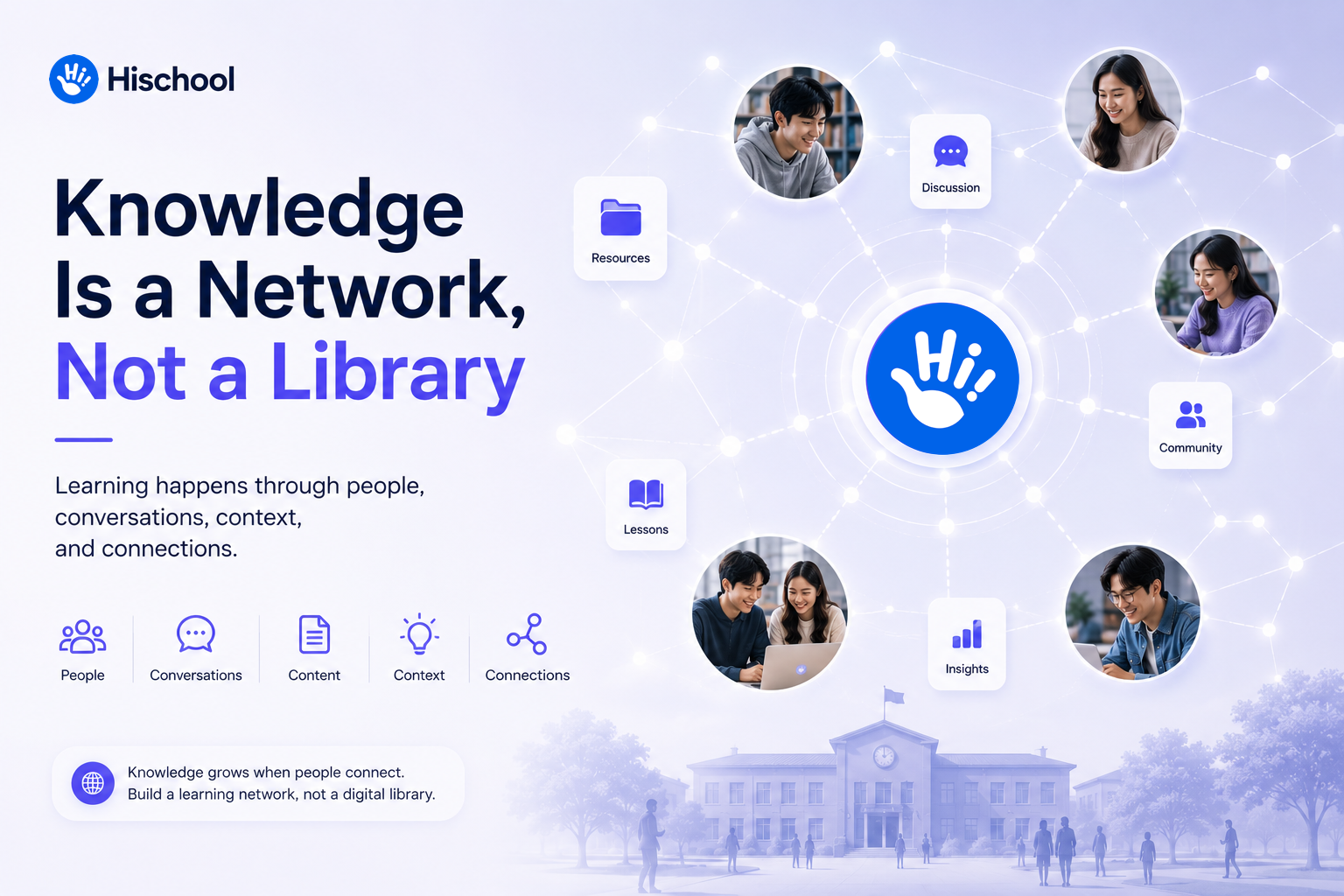
Knowledge is not a library.
Knowledge is a network.
Information is not knowledge
Most organizations have more information than ever before.
Documents.
Files.
Videos.
Presentations.
Messages.
Resources.
Yet people still struggle to find answers.
Why?
Because information alone is not knowledge.
Knowledge only becomes useful when people understand:
- Where it came from
- Why it matters
- Who it relates to
- When it was created
- How it connects to other ideas
Without context, information is just data.
Learning happens through connections
Think about the last time you learned something meaningful.
It probably wasn’t from a document alone.
You learned through:
- A conversation
- A question
- A discussion
- A project
- A mentor
- A community
Learning happens when ideas connect.
Not when files accumulate.
Knowledge lives inside people
Organizations often try to preserve knowledge by storing documents.
But the most valuable knowledge usually lives somewhere else.
Inside people.
Their experiences.
Their decisions.
Their conversations.
Their mistakes.
Their insights.
The challenge is not storing knowledge.
The challenge is connecting people to knowledge.
Context creates meaning
Imagine finding a document from three years ago.
You can read it.
But can you understand it?
Often the answer is no.
Because what matters is not only the document.
It’s the context around it.
Who wrote it?
Why was it written?
What discussion led to it?
What decisions came after it?
Context transforms information into knowledge.
Libraries organize content
Networks organize relationships
Traditional systems focus on content.
Folders.
Categories.
Documents.
Libraries.
These structures are useful.
But they only organize information.
Networks organize something more powerful.
Relationships.
Relationships between:
- People
- Ideas
- Discussions
- Projects
- Communities
And this is where real knowledge emerges.
Schools are knowledge networks
A school is not a collection of documents.
It is not a collection of courses.
It is a living network.
Students connect with teachers.
Teachers connect with ideas.
Ideas connect with projects.
Projects connect with communities.
Learning happens inside these connections.
When those connections disappear, knowledge becomes fragmented.
Why traditional systems struggle
Most educational systems were built around content.
Upload files.
Create lessons.
Store resources.
Manage courses.
These things matter.
But they are only part of learning.
The missing piece is the network.
The relationships that give content meaning.
The future belongs to connected knowledge
The most successful learning environments of the future will not simply store information.
They will connect it.
They will help people discover:
- Relevant conversations
- Related ideas
- Shared experiences
- Community knowledge
Not through search alone.
But through relationships.
So we built Hischool
We didn’t build a digital library.
We built a learning network.
A place where:
- Groups connect people
- Conversations preserve context
- Content stays connected to learning
- Communities create shared knowledge
- Learning grows through participation
Knowledge doesn’t live in isolated folders.
It lives inside a connected network.
Knowledge grows when people connect
The value of knowledge is not how much you store.
It’s how effectively people can access, understand, and build upon it.
That requires more than content.
It requires connection.
Because knowledge is not a library.
👉 It is a network.
Build a connected learning network
The future of learning is not better storage.
It’s better connections.